Greek myths
© Marinus Jan Marijs
Index (Click on the links here below to select the stories)
1. Pantheon of Greek gods
2. Wrath of the gods / titans
3. Poseidon
4. Cyclops
5. Theseus / minotaur
6. Scylla
7. Hercules / Heracles
8. Mercury
9. Icarus
10. Atlas
11. Golden fleece
12. Fall of Phaeton
13. Jason and the Argonauts
14. Prometheus
15. Perseus
16. Pygmalion
17. Narcissus
18. King Midas
19. Pandora’s box
20. Asclepius
21. Arachne
22. Plato’s cave
23. Pegasus
24. Orpheus
25. Battle of the titans
26. Sisyphus
27. Oedipus
28. Harpy
29. Centaur
30. Sirens
31. Griffin
32. Gorgon
33. Cerberus
34. Hydra
35. Charybdis
36. Circe
37. Nereid
38. Odyssey
1. Pantheon of Greek gods

Synopsis:
The twelve main Olympians are:
- Zeus (Jupiter, in Roman mythology): The king of all the gods (and father to many) and god of weather, law and fate
- Hera (Juno): The queen of the gods and goddess of women and marriage
- Aphrodite (Venus): Goddess of beauty and love
- Apollo (Apollo): God of prophesy, music and poetry and knowledge
- Ares (Mars): God of war
- Artemis (Diana): Goddess of hunting, animals and childbirth
- Athena (Minerva): Goddess of wisdom and defense
- Demeter (Ceres): Goddess of agriculture and grain
- Dionysus (Bacchus): Gof wine, pleasure and festivity
- Hephaistos (Vulcan): God of fire, metalworking and sculpture
- Hermes (Mercury): God of travel, hospitality and trade and Zeus’s personal messenger
- Poseidon (Neptune): God of the sea
 The Gods on mount Olympus Antonio Verrio (c.1636–1639–1707)
Synopsis:
The twelve main Olympians are:
- Zeus (Jupiter, in Roman mythology): The king of all the gods (and father to many) and god of weather, law and fate
- Hera (Juno): The queen of the gods and goddess of women and marriage
- Aphrodite (Venus): Goddess of beauty and love
- Apollo (Apollo): God of prophesy, music and poetry and knowledge
- Ares (Mars): God of war
- Artemis (Diana): Goddess of hunting, animals and childbirth
- Athena (Minerva): Goddess of wisdom and defense
- Demeter (Ceres): Goddess of agriculture and grain
- Dionysus (Bacchus): Gof wine, pleasure and festivity
- Hephaistos (Vulcan): God of fire, metalworking and sculpture
- Hermes (Mercury): God of travel, hospitality and trade and Zeus’s personal messenger
- Poseidon (Neptune): God of the sea
Interpretation:
The titans where generally personifications of the forces of nature.
The myths of the Olympians however, are allegorical narratives that are psychological dramas whose scene is the inner world;
According to Carl Jung: ”Deities are personified representations of the unconscious”.
Zeus (Jupiter, in Roman mythology): The king of all the gods.
He represents the self-structure.
Hera (Juno): The queen of the gods and goddess of women and marriage.
She represents the social capacity.
Aphrodite (Venus): Goddess of beauty and love.
She represents the aesthetical capacity.
Apollo (Apollo): God of prophesy, music and poetry and knowledge.
He represents art.
Ares (Mars): God of war.
He represents the aggression.
Artemis (Diana): Goddess of hunting, animals and childbirth.
She represents the ability to reach ones goal, and regeneration.
Athena (Minerva): Goddess of wisdom and defense.
She represents the capacity for understanding.
Demeter (Ceres): Goddess of agriculture and grain.
She represents the capacity for growing, development.
Dionysus (Bacchus): God of wine, pleasure and festivity.
He represents the capacity for joy, ecstasy.
Hephaistos (Vulcan): God of fire, metalworking and sculpture.
He represents the ability to create.
Hermes (Mercury): God of travel, hospitality and trade and Zeus’s personal messenger.
He represents the transcendent.
Poseidon (Neptune): God of the sea.
He represents the forces of the unconscious.
2. Wrath of the gods / titans

Synopsis:
THE TITANES (Titans) were six elder gods named Kronos (Cronus), Koios (Coeus), Krios (Crius), Iapetos (Iapetus), Hyperion and Okeanos (Oceanus), sons of Ouranos (Uranus, Sky) and Gaia (Gaea, Earth), who ruled the cosmos before the Olympians came to power. When their father was king he imprisoned six giant brothers of the Titanes–the Kyklopes (Cyclopes) and Hekatonkheires (Hecatoncheires)–in the belly of Earth. Gaia was incensed and incited her Titan sons to rebel. Led by Kronos, five of the six brothers, laid an ambush for their father, seizing hold of him as he descended to lie upon Earth. Four of them–Hyperion, Krios, Koios and Iapetos–were posted at the four corners of the earth to hold Sky fast, while Kronos in the centre castrated him with an adamantine sickle. After they had seized control of the cosmos, the Titanes released their storm giant brothers from Gaia’s belly, only to lock them away shortly afterwards in the pit of Tartaros (Tartarus).
Ouranos and Gaia prophesied that a son of Kronos would eventually depose the Titanes, and so the Titan-king, in fear for his throne, took to devouring each one of his offspring as soon as they were born. Only Zeus escaped this fate through the intervention of his mother Rhea, who deposited him in a cave on the island of Krete (Crete) and fed Kronos a substitute rock. Upon reaching adulthood, Zeus forced Kronos to disgorge his siblings, and with an army of divine-allies, made war on the Titanes and cast them into the pit of Tartaros (Tartarus). According to some (e.g. Pindar and Aeschylus) Kronos and the Titanes were later released from this prison, and the old Titan became king of Elysion (Elysium).
Interpretation:
While the Olympians can be seen as personifications of archetypical psychological structures, the titans can be seen as physical forces of nature, which were anthropomorphised.
The shift from the titans who represented physical forces of nature, to the Olympian Gods who can be seen as personifications of archetypical psychological structures, was around the eighth century BC.
3. Poseidon
 Ivan Konstantinovich Aivazovsky (29 July 1817 – 2 May 1900), Poseidon’s Sea Journey
Synopsis:
Poseidon is one of the twelve Olympian deities of the pantheon in Greek mythology. His main domain is the ocean, and he is called the “God of the Sea”. Additionally, he is referred to as “Earth-Shaker” due to his role in causing earthquakes.
Interpretation:
Poseidon represents the forces of the unconscious, being beneath the waves, causing storms and earthquakes.
4. Cyclops

Odysseus and his crew escape the cyclops, as painted by Arnold Böcklin in 1896
Synopsis:
A Cyclops in Greek mythology and later Roman mythology, was a member of a primordial race of giants, each with a single eye in the middle of his forehead. The name is widely thought to mean “round-eyed” or “circle-eyed”.
Odysseus is telling the Cyclops Polyphemus that his name is Οὖτις, “Nobody”, then escaping after blinding Polyphemus. When asked by other Cyclopes why he is screaming, Polyphemus replies that “Nobody” is hurting him, so the others assume that, “If alone as you are [Polyphemus] none uses violence on you, why, there is no avoiding the sickness sent by great Zeus; so you had better pray to your father, the lord Poseidon”.
Interpretation:
The Cyclops signifies the ego. The island stands for the egocentric world that holds the soul imprisoned. Odysseus spins a beam in Polyphemus’ eye, means the elimination of one’s egocentric view.
By saying he is “Nobody”, he renounces his identification with the ego and can escape from captivity.
5. Theseus / minotaur

Synopsis:
Minotaur, Greek Minotauros (“Minos’s Bull”), in Greek mythology, a fabulous monster of Crete that had the body of a man and the head of a bull. It was the offspring of Pasiphae, the wife of Minos, and a snow-white bull sent to Minos by the god Poseidon for sacrifice. Minos, instead of sacrificing it, kept it alive; Poseidon as a punishment made Pasiphae fall in love with it. Her child by the bull was shut up in the Labyrinth created for Minos by Daedalus.
A son of Minos, Androgeos, was later killed by the Athenians; to avenge his death, Minos demanded that seven Athenian youths and seven maidens should be sent every ninth year (or, according to another version, every year) to be devoured by the Minotaur. When the third time of sacrifice came, the Athenian hero Theseus volunteered to go, and, with the help of Ariadne, daughter of Minos and Pasiphae, he killed the monster and ended the tribute. Theseus escaped with Ariadne. –

Interpretation:
The minotaur, who is half human and half animal, represents the lower nature of men.
Theseus who represents the higher nature of men battles with his lower nature. The labyrinth is symbolic for the illusionary lower world in which one gets lost. The thread of Ariadne represents the intuition that makes it possible to escape from this illusionary mental world.
The modern psychological Subject – Object theory from Robert Kegan seems to be in place here.
6. Scylla

Synopsis:
Scylla was a monster with four eyes and six long necks equipped with grisly heads, each of which contained three rows of sharp teeth. Her body consisted of 12 tentacle-like legs and a cat’s tail, while four to six dog-heads ringed her waist. In this form, she attacked the ships of passing sailors, seizing one of the crew with each of her heads.
Interpretation:
The Scylla is another symbol of the lower forces within a person.
A passing ship in danger of being destroyed, refers to the lower forces within a person which keep one away from ones destiny.
7. Hercules / Heracles
 Apotheosis of Hercules by François Le Moyne (1688 – 4 June 1737)
Synopsis:
Heracles, Greek Herakles, Roman Hercules, one of the most famous Greco-Roman legendary heroes. Traditionally, Heracles was the son of Zeus and Alcmene (see Amphitryon), granddaughter of Perseus. Zeus swore that the next son born of the Perseid house should become ruler of Greece, but—by a trick of Zeus’s jealous wife, Hera—another child, the sickly Eurystheus, was born first and became king. When Heracles grew up, he had to serve Eurystheus and also suffer the vengeful persecution of Hera; his first exploit was the strangling of two serpents that she had sent to kill him in his cradle.
Heracles waged a victorious war against the kingdom of Orchomenus in Boeotia and married Megara, daughter of Creon, king of Thebes, but he killed her and their children in a fit of madness sent by Hera and, consequently, was obliged to become the servant of Eurystheus. It was Eurystheus who imposed upon Heracles the famous Labours, later arranged in a cycle of 12, usually as follows: (1) the slaying of the Nemean lion, whose skin he thereafter wore; (2) the slaying of the nine-headed Hydra of Lerna; (3) the capture of the elusive hind (or stag) of Arcadia; (4) the capture of the wild boar of Mount Erymanthus; (5) the cleansing, in a single day, of the cattle stables of King Augeas of Elis; (6) the shooting of the monstrous man-eating birds of the Stymphalian marshes; (7) the capture of the mad bull that terrorized the island of Crete; (8) the capture of the man-eating mares of King Diomedes of the Bistones; (9) the taking of the girdle of Hippolyte, queen of the Amazons; (10) the seizing of the cattle of the three-bodied giant Geryon, who ruled the island Erytheia (meaning red) in the far west; (11) the bringing back of the golden apples kept at the world’s end by the Hesperides; and (12) the fetching up from the underworld of the triple-headed dog Cerberus, guardian of its gates.
Having completed the Labours, Heracles undertook further enterprises, including warlike campaigns. He also successfully fought the river god Achelous for the hand of Deianeira. As he was taking her home, the Centaur Nessus tried to violate her, and Heracles shot him with one of his poisoned arrows. The Centaur, dying, told Deianeira to preserve the blood from his wound, for if Heracles wore a garment rubbed with it he would love none but her forever. Several years later Heracles fell in love with Iole, daughter of Eurytus, king of Oechalia. Deianeira, realizing that Iole was a dangerous rival, sent Heracles a garment smeared with the blood of Nessus. The blood proved to be a powerful poison, and Heracles died. His body was placed on a pyre on Mount Oeta (Modern Greek Oíti), his mortal part was consumed, and his divine part ascended to heaven. There he was reconciled to Hera and married Hebe.
In art and literature, Heracles was represented as an enormously strong man of moderate height, a huge eater and drinker, very amorous, and generally kindly but with occasional outbursts of brutal rage. His characteristic weapon was the bow but frequently also the club.
In Italy he was worshipped as a god of merchants and traders, although others also prayed to him for his characteristic gifts of good luck or rescue from danger.
Hercules is known for his many adventures, which took him to the far reaches of the Greco-Roman world. One cycle of these adventures became canonical as the “Twelve Labours”, but the list has variations. One traditional order of the labours is found in the Bibliotheca as follows:
- Slay the Nemean Lion.
- Slay the nine-headed Lernaean Hydra.
- Capture the Golden Hind of Artemis.
- Capture the Erymanthian Boar.
- Clean the Augean stables in a single day.
- Slay the Stymphalian Birds.
- Capture the Cretan Bull.
- Steal the Mares of Diomedes.
- Obtain the girdle of Hippolyta, Queen of the Amazons.
- Obtain the cattle of the monster Geryon.
- Steal the apples of the Hesperides.
- Capture and bring back Cerberus.
Interpretation:
The narrative of Hercules and his tasks is a symbolic representation of a spiritual process.
The protagonists are personified representations of mental drives, psychological structures and forces in the subconscious.
1. Slay the ego
2. Silence greediness
3. To reach ones goal very swift
4. Eliminate powerful mental obstacles
5. To remove the psychological complexes from the subconscious
6. Slay the compulsions from the lower nature
7. To master ones emotional impulses
8. To control the unrestrained mind
9. To reach a higher spiritual capability
10. To reach deep into the subconscious
11. Require that which isn’t earthly
12. Conquer the elements that obstruct passage to equanimity
Buddhism has its ten fetters, an intrapsychic phenomenon, which ties one to suffering and one have to be cut through, to reach enlightenment.
8. Mercury

The Souls of Acheron (1898) Adolf Hirémy-Hirschl, (1860–1933)
Synopsis:
Mercury, Latin Mercurius, in Roman religion, god of shopkeepers and merchants, travelers and transporters of goods, and thieves and tricksters. He is commonly identified with the Greek Hermes, the fleet-footed messenger of the gods.
The cult of Mercury is ancient, and tradition has it that his temple on the Aventine Hill in Rome was dedicated in 495 bce. There Mercury was associated with Maia, who became identified as his mother through her association with the Greek Maia, one of the Pleiades, who was the mother of Hermes by Zeus; likewise, because of that Greek connection, Mercury was considered the son of Jupiter.
Interpretation:
Mercury or Hermes is what is called a psychopomp, serving to sever the last ties between the soul and the body, and to guide the deceased to the afterlife. He is also wearing winged sandals or a winged cap and carries a caduceus (staff), which is a symbol for the kundalini system which is the connection between body and soul.
Further information:
Psychopomps (from the Greek word, literally meaning the “guide of souls”) are creatures, spirits, angels, or deities in many religions whose responsibility is to escort newly deceased souls from Earth to the afterlife. Their role is not to judge the deceased, but simply to provide safe passage. Appearing frequently on funerary art, psychopomps have been depicted at different times and in different cultures as anthropomorphic entities, horses, deer, dogs, whip-poor-wills, ravens, crows, owls, sparrows and cuckoos. When seen as birds, they are often seen in huge masses, waiting outside the home of the dying.
Classical examples of a psychopomp are the ancient Egyptian god Anubis, the Greek ferryman Charon and deities Hermes and Hecate, the Roman god Mercury, and the Etruscan deity Vanth.
Religion
The form of Shiva as Tarakeshwara in Hinduism performs a similar role, although leading the soul to moksha rather than an afterlife. Additionally, in the Bhagavata Purana, the Visnudutas and Yamadutas are also messengers for their respective masters, Vishnu and Yama. Their role is illustrated vividly in the story of Ajamila. In many beliefs, a spirit being taken to the underworld is violently ripped from its body.
In the Persian tradition, Daena, the Zoroastrian Self-guide, appears as a beautiful young maiden to those who deserve to cross the Chinvat Bridge or a hideous old hag to those who don’t.
In Judaism and Islam, Azrael plays the role of the angel of death who carries the soul up to the heavens.
In many cultures, the shaman also fulfills the role of the psychopomp. This may include not only accompanying the soul of the dead, but also to help at birth, to introduce the newborn child’s soul to the world. This also accounts for the contemporary title of “midwife to the dying”, or “End of Life Doula”, which is another form of psychopomp work.
Psychology
In Jungian psychology, the psychopomp is a mediator between the unconscious and conscious realms. It is symbolically personified in dreams as a wise man or woman, or sometimes as a helpful animal. (Wikipedia)
9. Icarus
 Herbert James Draper (1863 – 1920)
Synopsis:
In Greek mythology, Icarus is the son of the master craftsman Daedalus, the creator of the Labyrinth. Often depicted in art, Icarus and his father attempt to escape from Crete by means of wings that his father constructed from feathers and wax. Icarus’ father warns him first of complacency and then of hubris, asking that he fly neither too low nor too high, so the sea’s dampness would not clog his wings or the sun’s heat melt them. Icarus ignored his father’s instructions not to fly too close to the sun; when the wax in his wings melted he tumbled out of the sky and fell into the sea where he drowned.
Icarus’ father Daedalus, a very talented and remarkable Athenian craftsman, built the Labyrinth for King Minos of Crete near his palace at Knossos to imprison the Minotaur, a half-man, half-bull monster born of his wife and the Cretan bull. Minos imprisoned Daedalus himself in the labyrinth because he gave Minos’s daughter, Ariadne, a clew (or ball of string) in order to help Theseus, the enemy of Minos, to survive the Labyrinth and defeat the Minotaur.
Daedalus fashioned two pairs of wings out of wax and feathers for himself and his son. Daedalus tried his wings first, but before trying to escape the island, he warned his son not to fly too close to the sun, nor too close to the sea, but to follow his path of flight. Overcome by the giddiness that flying lent him, Icarus soared into the sky, but in the process he came too close to the sun, which due to the heat melted the wax. Icarus kept flapping his wings but soon realized that he had no feathers left and that he was only flapping his bare arms, and so Icarus fell into the sea in the area which today bears his name, the Icarian Sea near Icaria, an island southwest of Samos.
Literary interpretation has found in the myth the structure and consequence of personal over-ambition. In psychology there have been synthetic studies of the Icarus complex with respect to the alleged relationship between fascination for fire, enuresis, high ambition, and ascensionism. In the psychiatric mind features of disease were perceived in the shape of the pendulous emotional ecstatic-high and depressive-low of bipolar disorder. Henry Murray having proposed the term Icarus complex, apparently found symptoms particularly in mania where a person is fond of heights, fascinated by both fire and water, narcissistic and observed with fantastical or far-fetched imaginary cognition.
Icarus, in Greek mythology, son of the inventor Daedalus who perished by flying too near the Sun with waxen wings
Interpretation:
This tragic theme of failure because of hubris and over-ambition contains similarities to that of Phaëthon. A theme that returns in many Greek myths.
10. Atlas

Synopsis:
Atlas, in Greek mythology, son of the Titan Iapetus and the Oceanid Clymene (or Asia) and brother of Prometheus (creator of humankind). In Homer’s Odyssey, Book I, Atlas seems to have been a marine creature who supported the pillars that held heaven and earth apart. These were thought to rest in the sea immediately beyond the most western horizon, but later the name of Atlas was transferred to a range of mountains in northwestern Africa. Atlas was subsequently represented as the king of that district, turned into a rocky mountain by the hero Perseus, who, to punish Atlas for his inhospitality, showed him the Gorgon’s head, the sight of which turned men to stone. According to Hesiod’s Theogony, Atlas was one of the Titans who took part in their war against Zeus, for which as a punishment he was condemned to hold aloft the heavens. In many works of art he was represented as carrying the heavens (in Classical art from the 6th century bce) or the celestial globe (in Hellenistic and Roman art).
Interpretation:
He who tries to resist kosmic forces, will carry the world on his shoulder.
11. Golden fleece
 Herbert James Draper (1863 – 1920)
Synopsis:
In Greek mythology, the Golden Fleece is the fleece of the gold-haired winged ram, which was held in Colchis. The fleece is a symbol of authority and kingship. It figures in the tale of the hero Jason and his crew of Argonauts, who set out on a quest for the fleece by order of King Pelias, in order to place Jason rightfully on the throne of Iolcus in Thessaly. Through the help of Medea, they acquire the Golden Fleece. The story is of great antiquity and was current in the time of Homer (eighth century BC).
Athamas the Minyan, a founder of Halos in Thessaly but also king of the city of Orchomenus in Boeotia (a region of southeastern Greece), took the goddess Nephele as his first wife. They had two children, the boy Phrixus (whose name means “curly”—as in ram’s fleece) and the girl Helle. Later Athamas became enamored of and married Ino, the daughter of Cadmus. When Nephele left in anger, drought came upon the land.
Ino was jealous of her stepchildren and plotted their deaths: in some versions, she persuaded Athamas that sacrificing Phrixus was the only way to end the drought. Nephele, or her spirit, appeared to the children with a winged ram whose fleece was of gold. The ram had been sired by Poseidon in his primitive ram-form upon Theophane, a nymph and the granddaughter of Helios, the sun-god. According to Hyginus, Poseidon carried Theophane to an island where he made her into a ewe, so that he could have his way with her among the flocks. There Theophane’s other suitors could not distinguish the ram-god and his consort.
Nepheles’ children escaped on the yellow ram over the sea, but Helle fell off and drowned in the strait now named after her, the Hellespont. The ram spoke to Phrixus, encouraging him, and took the boy safely to Colchis (modern-day Georgia), on the easternmost shore of the Euxine (Black) Sea.
There Phrixus sacrificed the winged ram to Poseidon, essentially returning him to the god. The ram became the constellation Aries.
Phrixus settled in the house of Aeetes, son of Helios the sun god. He hung the Golden Fleece preserved from the sacrifice of the ram on an oak in a grove sacred to Ares, the god of war and one of the Twelve Olympians.
Interpretation:
The golden fleece was defended by bulls with hoofs of brass and breath of fire. It was also guarded by a never sleeping dragon with teeth which could become soldiers when planted in the ground. The dragon was at the foot of the tree on which the fleece was placed.
The golden fleece is a symbol for reaching a high mystical level by traveling inward and confronting the forces of the subconscious.
12. Fall of Phaeton
 Sebastiano Ricci (1659-1734)
Synopsis:
Phaethon, challenged by his playmates, sought assurance from his mother that his father was the sun god Helios. She gave him the requested assurance and told him to turn to his father for confirmation. He asked his father for some proof that would demonstrate his relationship with the sun. When the god promised to grant him whatever he wanted, he insisted on being allowed to drive the sun chariot for a day. Placed in charge of the chariot, he was unable to control the horses. The Earth was in danger of being burnt up and, to prevent this disaster, Zeus was forced to strike down the chariot with a thunderbolt and kill Phaethon in the process.
Ovid’s version
In the version of the myth told by Ovid in the Metamorphoses, Phaethon ascends into heaven, the home of his suspected father. His mother Clymene had boasted that his father was the Sun-God or Phoebus. Phaethon went to his father who swore by the river Styx to give Phaethon anything he would ask for in order to prove his divine sonship. Phaethon wanted to drive the chariot of the sun for a day. Phoebus tried to talk him out of it by telling him that not even Jupiter (the king of the gods) would dare to drive it, as the chariot was fiery hot and the horses breathed out flames.
The fall of Phaethon
Phaethon was adamant. When the day came, the fierce horses that drew the chariot felt that it was empty because of the lack of the sun-god’s weight and went out of control. Terrified, Phaethon dropped the reins. The horses veered from their course, scorching the earth, burning the vegetation, bringing the blood of the Ethiopians to the surface of their skin and so turning it black, changing much of Africa into desert, drying up rivers and lakes and shrinking the sea. Earth cried out to Jupiter who was forced to intervene by striking Phaethon with a lightning bolt. Like a falling star, Phaethon plunged blazing into the river Eridanos.
The epitaph on his tomb was:
Here Phaethon lies who in the sun-god’s chariot fared. And though greatly he failed, more greatly he dared.
Phoebus, stricken with grief at his son’s death, at first refused to resume his work of driving his chariot, but at the appeal of the other gods, including Jupiter, returned to his task.
Interpretation:
The story is about the consequences of pride and even similar to the fall of Lucifer.
13. Jason and the Argonauts
 The Argo – Constantinos Volonakis (1837-1907)
Synopsis:
Jason and the Argonauts
Pelias seized Iolcos, and thus for safety Jason was sent away to the Centaur Chiron. Returning as a young man, Jason was promised his inheritance if he fetched the Golden Fleece for Pelias, a seemingly impossible task. After many adventures Jason abstracted the fleece with the help of the enchantress Medea, whom he married. On their return Medea murdered Pelias, but she and Jason were driven out by Pelias’ son and had to take refuge with King Creon of Corinth. Later Jason deserted Medea for Creon’s daughter; this desertion and its consequences formed the subject of Euripides’ Medea.
Argonaut, in Greek legend, any of a band of 50 heroes who went with Jason. Jason, in Greek mythology, leader of the Argonauts and son of Aeson, king of Iolcos in Thessaly. His father’s half-brother in the ship Argo to fetch the Golden Fleece. Jason’s uncle Pelias had usurped the throne of Iolcos in Thessaly, which rightfully belonged to Jason’s father, Aeson. Pelias promised to surrender his kingship to Jason if the latter would retrieve the Golden Fleece from Colchis.
The Golden Fleece had originated in the following manner. Jason’s uncle Athamas had had two children, Phrixus and Helle, by his first wife, Nephele, the cloud goddess. Ino, his second wife, hated the children of Nephele and persuaded Athamas to sacrifice Phrixus as the only means of alleviating a famine. But before the sacrifice, Nephele appeared to Phrixus, bringing a ram with a golden fleece on which he and his sister Helle tried to escape over the sea. Helle fell off and was drowned in the strait that after her was called the Hellespont. Phrixus safely reached the other side, and, proceeding to Colchis on the farther shore of the Euxine (Black) Sea, he sacrificed the ram and hung up its fleece in the grove of Ares, where it was guarded by a sleepless dragon.
Jason, having undertaken the quest of the fleece, called upon the noblest heroes of Greece to take part in the expedition. According to the original story, the crew consisted of the chief members of Jason’s own race, the Minyans; later, other and better-known heroes, such as Castor and Polydeuces, were added to their number.
The Argonauts arrived at Lemnos, which was occupied only by women, and remained there several months. Proceeding up the Hellespont, they sailed to the country of the Doliones, by whose king, Cyzicus, they were hospitably received. After their departure, however, they were driven back to the same place by a storm and were attacked by the Doliones, who did not recognize them, and in the ensuing battle Jason killed Cyzicus. On reaching the country of the Bebryces, the Argonauts were challenged by the king Amycus, who forced all passing travelers to box with him in the hope of killing them. Polydeuces accepted the challenge and slew him. At the entrance to the Euxine Sea the Argonauts met Phineus, the blind and aged king whose food was constantly polluted by the Harpies. After being freed by the winged sons of Boreas, Phineus told them the course to Colchis and how to pass through the Symplegades, or Cyanean rocks—two cliffs that moved on their bases and crushed whatever sought to pass. Following his advice, Jason sent ahead a dove that was damaged between the rocks, but thanks to Athena the Argo slipped through while the rocks were rebounding. From that time the rocks became fixed and never closed again.
When the Argonauts finally reached Colchis, they found that the king, Aeëtes, would not give up the fleece until Jason yoked the king’s fire-snorting bulls to a plow and plowed the field of Ares. That accomplished, the field was to be sown with dragon’s teeth from which armed men were to spring. Aeëtes’ daughter, the sorceress Medea, who had fallen in love with Jason, gave him a salve that protected him from the bulls’ fire and advised him to cast a stone at the newborn warriors to cause them to fight to the death among themselves. After these tasks were accomplished, Aeëtes still refused to give over the fleece. Medea, however, put the dragon to sleep, and Jason was able to abscond with the fleece and Medea. Various accounts are given of the homeward course; eventually the Argo reached Iolcos and was placed in a grove sacred to Poseidon in the Isthmus of Corinth.
Interpretation:
Jason, who undertakes the quest of the fleece, and called upon the noblest heroes of Greece to take part in the expedition, describes in an allegorical narrative the inner voyage the human soul takes to reach its spiritual destiny.
The fleece is a symbol of authority and kingship.
During his quest lower personal structures metaphorically described as bulls’ fire and a dragon, are been defeated.
And Jason was able to escape with the fleece and Medea.
14. Prometheus

Synopsis:
Prometheus, in Greek religion, one of the Titans, the supreme trickster, and a god of fire. His intellectual side was emphasized by the apparent meaning of his name, Forethinker. In common belief he developed into a master craftsman, and in this connection he was associated with fire and the creation of mortals.
The Greek poet Hesiod related two principal legends concerning Prometheus. The first is that Zeus, the chief god, who had been tricked by Prometheus into accepting the bones and fat of sacrifice instead of the meat, hid fire from mortals. Prometheus, however, stole it and returned it to Earth once again. As the price of fire, and as punishment for humankind in general, Zeus created the woman Pandora and sent her down to Epimetheus (Hindsight), who, though warned by Prometheus, married her. Pandora took the great lid off the jar she carried, and evils, hard work, and disease flew out to plague humanity. Hope alone remained within.
Hesiod relates in his other tale that, as vengeance on Prometheus, Zeus had him nailed to a mountain in the Caucasus and sent an eagle to eat his immortal liver, which constantly replenished itself; Prometheus was depicted in Prometheus Bound by Aeschylus, who made him not only the bringer of fire and civilization to mortals but also their preserver, giving them all the arts and sciences as well as the means of survival.
Interpretation:
Bringing fire and knowledge to mankind, the spirit will be bound.
15. Perseus

Benvenuto Cellini (Florence, 3 november 1500 – Florence, 13 februari 1571)
Synopsis:
Perseus, in Greek mythology, the slayer of the Gorgon Medusa and the rescuer of Andromeda from a sea monster. Perseus was the son of Zeus and Danaë, the daughter of Acrisius of Argos. As an infant he was cast into the sea in a chest with his mother by Acrisius, to whom it had been prophesied that he would be killed by his grandson. After Perseus had grown up on the island of Seriphus, where the chest had grounded, King Polydectes of Seriphus, who desired Danaë, tricked Perseus into promising to obtain the head of Medusa, the only mortal among the Gorgons.
Aided by Hermes and Athena, Perseus pressed the Graiae, sisters of the Gorgons, into helping him by seizing the one eye and one tooth that the sisters shared and not returning them until they provided him with winged sandals (which enabled him to fly), the cap of Hades (which conferred invisibility), a curved sword, or sickle, to decapitate Medusa, and a bag in which to conceal the head. (According to another version, the Graiae merely directed him to the Stygian Nymphs, who told him where to find the Gorgons and gave him the bag, sandals, and helmet; Hermes gave him the sword.) Because the gaze of Medusa turned all who looked at her to stone, Perseus guided himself by her reflection in a shield given him by Athena and beheaded Medusa as she slept. He then returned to Seriphus and rescued his mother by turning Polydectes and his supporters to stone at the sight of Medusa’s head.
A further deed attributed to Perseus was his rescue of the Ethiopian princess Andromeda when he was on his way home with Medusa’s head. Andromeda’s mother, Cassiopeia, had claimed to be more beautiful than the sea nymphs, or Nereids; so Poseidon had punished Ethiopia by flooding it and plaguing it with a sea monster. An oracle informed Andromeda’s father, King Cepheus, that the ills would cease if he exposed Andromeda to the monster, which he did. Perseus, passing by, saw the princess and fell in love with her. He turned the sea monster to stone by showing it Medusa’s head and afterward married Andromeda.

Georges Clairin (1843 – 1919)
Interpretation:
The story of Perseus is a travel narrative which is situated in a mythological landscape, but its allegorical meaning is a voyage into an inner landscape.
His clash against the gorgon Medusa is a battle from the higher nature against the lower instinctual forces that are deep within the subconsciousness.
When the gorgon has been decapitated, which means the lower nature is eliminated, the head can be used to turn the sea monster to stone.
The sea monster represents other forces from the subconsciousness.
That Perseus married Andromeda, means that he realised a union, a mystical state.
16. Pygmalion
 Pygmalion and Galatea by Giulio Bargellini (1875 – 1936)
Synopsis:
Pygmalion, in Greek mythology, a king who was the father of Metharme and, through her marriage to Cinyras, the grandfather of Adonis, according to Apollodorus of Athens. The Roman poet Ovid, in his Metamorphoses, Book X, relates that Pygmalion, a sculptor, makes an ivory statue representing his ideal of womanhood and then falls in love with his own creation, which he names Galatea; the goddess Venus brings the statue to life in answer to his prayer. Their daughter Paphos gives her name to the city of Paphos, the centre of Aphrodite’s worship on Cyprus.
Interpretation:
The story is about the realisation of an ideal in the physical world.
17. Narcissus
 Caravaggio (28 September 1571 – 18 July 1610)
Synopsis:
In Greek mythology, Narcissus was a hunter from Thespiae in Boeotia who was known for his beauty. He was the son of the river god Cephissus and nymph Liriope, He was proud, in that he disdained those who loved him. Nemesis noticed this behaviour and attracted Narcissus to a pool, where he saw his own reflection in the water and fell in love with it, not realizing it was merely an image. Unable to leave the beauty of his reflection, Narcissus lost his will to live. He stared at his reflection until he died.
Interpretation:
The beautiful youth Narcissus, who fell in love with his own reflection is on one level a story about a fixation with oneself and one’s physical appearance or public perception.
On a deeper level it deals with the inability of humans to transcend ones self-structure and to be free from ones conditionings.
18. King Midas

Synopsis:
In Greek mythology, Midas was the name of a king in the region of Phrygia in Anatolia, modern-day Turkey. According to the myth, the god Dionysus was trying to find his teacher, the satyr Silenus, who had gone missing after drinking too much wine and wandered off. Silenus was found by the men of Midas, who brought him to the king; Midas recognised him and offered his hospitality for ten days, before taking him back to the region of Lydia, where Dionysus was. The god was so happy that he told Midas he would fulfill one wish for him. Midas asked that everything he touched would become gold, and Dionysus kindly granted the wish.
Midas was particularly excited with his new power and started turning trees and rocks into gold, on his way back home. When he reached his palace, he asked his servants to prepare a grand feast, but to his despair, he soon realised that the food he touched also turned into gold and would soon die of starvation. Even his daughter turned into gold when she greeted her father. Midas, realising that his wish was actually foolish, prayed to Dionysus, who told him to wash in the river Pactolus; everything he would place in the river after that would also turn back to normal. Midas went straight to the river and felt his powers leave him and flow into the waters. In fact, the sands of the river turned gold, explaining the rich minerals that were found in the river by the ancient inhabitants of the area. Midas, relieved of his bane, decided to deny all riches and retreated to the countryside
Interpretation:
The story of King Midas is a myth about the tragedy of avarice and narrates what happens when true happiness is not recognized. Midas was a man who wished that everything he touched would turn into gold. However, he had not thought that this wish was not actually a blessing, but a curse. His greed invites us to think and realize its consequences that may lead us to become slaves of our own desires.
19. Pandora’s box

Synopsis:
In Greek mythology, Pandora (Greek: “the all-gifted” or “the all-giving”) was the first human woman created by the gods, specifically by Hephaestus and Athena on the instructions of Zeus. As Hesiod related it, each god helped create her by giving her unique gifts. Zeus ordered Hephaestus to mould her out of earth as part of the punishment of humanity for Prometheus’ theft of the secret of fire, and all the gods joined in offering her “seductive gifts”.
According to the myth, Pandora opened a jar (pithos), in modern accounts sometimes mistranslated as “Pandora’s box”, releasing all the evils of humanity—although the particular evils, aside from plagues and diseases, are not specified in detail by Hesiod—leaving only Hope inside once she had closed it again.
Hesiod also outlines how the end of man’s Golden Age The opening of the jar serves as the beginning of the Silver Age, in which man is now subject to death, and with the introduction of woman to birth as well, giving rise to the cycle of death and rebirth.
Interpretation:
The story of Pandora has remarkable similarities with the story of Eve.
Each were the first woman in the world and both wanted knowledge.
Both are a central character in a story of transition from an original state of plenty and ease to one of suffering and death, a transition which is brought about as a punishment for transgression of divine law.
The hidden meaning behind both stories is that they describe a transition from a state of being in which there is no mortality and no illness, to a state where there is suffering and death.
The release of all the evils on humanity means that when the human soul enters the physical world, it will be subject to suffering, illness and death.
20. Asclepius

A Sick Child brought into the Temple of Aesculapius 1877
John William Waterhouse (1849-1917)
Synopsis:
Every night for nearly a thousand years (500 B.C. – 500 A.D.), sick and afflicted pilgrims flocked to the Grecian Temples of Asclepius to take part of a ritual called incubation. The ancient kindly god of medicine was expected to visit them during a dream state and either heal or prescribe drugs, diet, and modes of treatment. Only requisites were that they should be clean and “think pure thoughts.” To show their appreciation, recipients of Asclepius’ favour caused votives (stone or terra cotta images of the afflicted parts which supposedly had been healed) to be made, suitably inscribed, and presented to be hung as testimony on the temple walls. More than 200 such temples existed.
Interpretation:
The staff of Asclepius which is similar to the kundalini from the Hindu and symbol mentioned in the Bible: The Nehushtan. This mystical archetypical image in now the symbol of the World Medical Association.
21. Arachne
 Amelie Lundahl, 1850 – 1914
Arachne, (Greek: “Spider”) in Greek mythology, the daughter of Idmon of Colophon in Lydia, a dyer in purple.
Arachne was a weaver who acquired such skill in her art that she ventured to challenge Athena, goddess of war, handicraft, and practical reason. Athena wove a tapestry depicting the gods in majesty, while that of Arachne showed their amorous adventures. Enraged at the perfection of her rival’s work (or, alternatively, offended by its subject matter), Athena tore it to pieces, and in despair Arachne hanged herself. But the goddess out of pity loosened the rope, which became a cobweb; Arachne herself was changed into a spider, whence the name of the zoological class to which spiders belong, Arachnida. Ovid’s Metamorphoses is the chief source of the story
In Greek mythology (and later Roman mythology), Arachne was a talented mortal weaver who challenged Athena, goddess of wisdom and crafts, to a weaving contest; this hubris resulted in her being transformed into a spider.
Interpretation:
On one level this story deals with hubris, but on a deeper level it is about someone how tries to weave his/ her destiny and gets trapped in this endeavour.
22. Plato’s cave

Synopsis:
The Allegory of the Cave, or Plato’s Cave, was presented by the Greek philosopher Plato in his work Republic (514a–520a) to compare “the effect of education and the lack of it on our nature”. It is written as a dialogue between Plato’s brother Glaucon and his mentor Socrates, narrated by the latter.
Plato has Socrates describe a group of people who have lived chained to the wall of a cave all of their lives, facing a blank wall. The people watch shadows projected on the wall from objects passing in front of a fire behind them, and give names to these shadows. The shadows are the prisoners’ reality. Socrates explains how the philosopher is like a prisoner who is freed from the cave and comes to understand that the shadows on the wall are not reality at all, for he can perceive the true form of reality rather than the manufactured reality that is the shadows seen by the prisoners. The inmates of this place do not even desire to leave their prison; for they know no better life. The prisoners manage to break their bonds one day, and discover that their reality was not what they thought it was. They discovered the sun, which Plato uses as an analogy for the fire that man cannot see behind. Like the fire that cast light on the walls of the cave, the human condition is forever bound to the impressions that are received through the senses. Even if these interpretations (or, in Kantian terminology, intuitions) are an absurd misrepresentation of reality, we cannot somehow break free from the bonds of our human condition – we cannot free ourselves from phenomenal state just as the prisoners could not free themselves from their chains. If, however, we were to miraculously escape our bondage, we would find a world that we could not understand – the sun is incomprehensible for someone who has never seen it. In other words, we would encounter another “realm,” a place incomprehensible because, theoretically, it is the source of a higher reality than the one we have always known; it is the realm of pure Form, pure fact.
Imprisonment in the cave
Plato begins by having Socrates ask Glaucon to imagine a cave where people have been imprisoned from birth. These prisoners are chained so that their legs and necks are fixed, forcing them to gaze at the wall in front of them and not look around at the cave, each other, or themselves (514a–b). Behind the prisoners is a fire, and between the fire and the prisoners is a raised walkway with a low wall, behind which people walk carrying objects or puppets “of men and other living things” (514b). The people walk behind the wall so their bodies do not cast shadows for the prisoners to see, but the objects they carry do (“just as puppet showmen have screens in front of them at which they work their puppets” (514a)). The prisoners cannot see any of what is happening behind them, they are only able to see the shadows cast upon the cave wall in front of them. The sounds of the people talking echo off the walls, and the prisoners believe these sounds come from the shadows (514c).
Socrates suggests that the shadows are reality for the prisoners because they have never seen anything else; they do not realize that what they see are shadows of objects in front of a fire, much less that these objects are inspired by real things outside the cave which they do not see (514b-515a).
Departure from the cave
Plato then supposes that one prisoner is freed. This prisoner would look around and see the fire. The light would hurt his eyes and make it difficult for him to see the objects casting the shadows. If he were told that what he is seeing is real instead of the other version of reality he sees on the wall, he would not believe it. In his pain, Plato continues, the freed prisoner would turn away and run back to what he is accustomed to (that is, the shadows of the carried objects). He writes “… it would hurt his eyes, and he would escape by turning away to the things which he was able to look at, and these he would believe to be clearer than what was being shown to him.” Plato continues: “Suppose… that someone should drag him… by force, up the rough ascent, the steep way up, and never stop until he could drag him out into the light of the sun.” The prisoner would be angry and in pain, and this would only worsen when the radiant light of the sun overwhelms his eyes and blinds him.
“Slowly, his eyes adjust to the light of the sun. First he can only see shadows. Gradually he can see the reflections of people and things in water and then later see the people and things themselves. Eventually, he is able to look at the stars and moon at night until finally he can look upon the sun itself (516a).” Only after he can look straight at the sun “is he able to reason about it” and what it is (516b).
Return to the cave
Plato continues, saying that the freed prisoner would think that the world outside the cave was superior to the world he experienced in the cave; “he would bless himself for the change, and pity [the other prisoners]” and would want to bring his fellow cave dwellers out of the cave, into the sunlight (516c).
The returning prisoner, whose eyes have become accustomed to the sunlight, would be blind when he re-enters the cave, just as he was when he was first exposed to the sun (516e). The prisoners, according to Plato, would infer from the returning man’s blindness that the journey out of the cave had harmed him and that they should not undertake a similar journey. Socrates concludes that the prisoners, if they were able, would therefore reach out and kill anyone who attempted to drag them out of the cave (517a).
Interpretation:
The allegory contains many forms of symbolism used to describe the state of the world. The cave is a symbol of the world and the prisoners are those who inhabit the world. The chains that prevent the prisoners from leaving the cave represent ignorance, meaning they interfere with the prisoners seeing the truth. The shadows cast on the walls of the cave represent what people see in the present world. The freed prisoners represent those in society who see the physical world for the illusion it is.
The allegory is related to Plato’s theory of Forms, according to which the “Forms” (or “Ideas”), and not the material world known to us through sensation, possess the highest and most fundamental kind of reality.
23. Pegasus

Synopsis:
Pegasus, in Greek mythology, a winged horse that sprang from the blood of the Gorgon Medusa as she was beheaded by the hero Perseus. With Athena’s (or Poseidon’s) help, another Greek hero, Bellerophon, captured Pegasus and rode him first in his fight with the Chimera and later while he was taking vengeance on Stheneboea (Anteia), who had falsely accused Bellerophon. Subsequently Bellerophon attempted to fly with Pegasus to heaven but was unseated and killed or, by some accounts, lamed. The winged horse became a constellation and the servant of Zeus. The spring Hippocrene on Mount Helicon was believed to have been created when the hoof of Pegasus struck a rock.
Interpretation:
Pegasus’s soaring flight is an allegory of the soul’s immortality. The ability to ascend into the sky symbolises the ability of the human soul to ascend to higher ontological levels of existence.
24. Orpheus

Synopsis:
Orpheus, ancient Greek legendary hero endowed with superhuman musical skills. He became the patron of a religious movement based on sacred writings said to be his own.
Traditionally, Orpheus was the son of a Muse (probably Calliope, the patron of epic poetry) and Oeagrus, a king of Thrace (other versions give Apollo). According to some legends, Apollo gave Orpheus his first lyre. Orpheus’s singing and playing were so beautiful that animals and even trees and rocks moved about him in dance.
Orpheus joined the expedition of the Argonauts, saving them from the music of the Sirens by playing his own, more powerful music. On his return, he married Eurydice, who was soon killed by a snakebite. Overcome with grief, Orpheus ventured himself to the land of the dead to attempt to bring Eurydice back to life. With his singing and playing he charmed the ferryman Charon and the dog Cerberus, guardians of the River Styx. His music and grief so moved Hades, king of the underworld, that Orpheus was allowed to take Eurydice with him back to the world of life and light. Hades set one condition, however: upon leaving the land of death, both Orpheus and Eurydice were forbidden to look back. The couple climbed up toward the opening into the land of the living, and Orpheus, seeing the Sun again, turned back to share his delight with Eurydice. In that moment, she disappeared. A famous version of the story was related by Virgil in Georgics, Book IV.
Bertrand Russell noted:
“The Orphics were an ascetic sect; wine, to them, was only a symbol, as, later, in the Christian sacrament. The intoxication that they sought was that of “enthusiasm,” of union with the god. They believed themselves, in this way, to acquire mystic knowledge not obtainable by ordinary means. This mystical element entered into Greek philosophy with Pythagoras, who was a reformer of Orphism as Orpheus was a reformer of the religion of Dionysus. From Pythagoras Orphic elements entered into the philosophy of Plato, and from Plato into most later philosophy that was in any degree religious.”
The myth theme of not looking back, an essential precaution in Jason’s raising of chthonic Brimo Hekate under Medea’s guidance, is reflected in the Biblical story of Lot’s wife when escaping from Sodom. More directly, the story of Orpheus is similar to the ancient Greek tales of Persephone captured by Hades and similar stories of Adonis captive in the underworld.
Interpretation:
One level of interpretation is that the story deals with some kind of out of the body experience in which Orpheus travels to a trans-physical world to find Eurydice.
On another level of interpretation one can say that this travel narrative relates to a psychological process in which a person goes deep into the subconscious.
In this spiritual process the deeper laying structures, who are personified by Eurydice, must be brought to the surface.
The condition, that upon leaving the land of death, both Orpheus and Eurydice were forbidden to look back is the theme of letting therast go, of not looking back.
An essential precaution in Jason’s raising of chthonic Brimo Hekate under Medea’s guidance, which is also reflected in the Biblical story of Lot’s wife when escaping from Sodom.
The condition means that the spiritual process can only succeed when past conditionings and identifications are left behind.
25. Battle of the titans
 Henri Martin – ‘Titans Fighting against Jupiter’, 1884-1885
Synopsis:
In Greek mythology, the Titanomachy (Titan battle”) was a ten-year[1] series of battles fought in Thessaly, consisting of most of the Titans (an older generation of gods, based on Mount Othrys) fighting against the Olympians (the younger generations, who would come to reign on Mount Olympus) and their allies. This event is also known as the War of the Titans, Battle of the Titans, Battle of the Gods, or just the Titan War. The war was fought to decide which generation of gods would have dominion over the universe; it ended in victory for the Olympian gods.
Interpretation:
The battle between the Titans (an older generation of gods, based on Mount Othrys) fighting against the Olympians (the younger generations, who would come to reign on Mount Olympus) and their allies, was a paradigmatic shift in Greek thinking.
The titans were generally personifications of the forces of nature, the physical elements; the Olympians personified psychological structures.
26. Sisyphus

Synopsis:
In Greek mythology Sisyphus or was the king of Ephyra (now known as Corinth). He is being punished for his self-aggrandizing craftiness and deceitfulness by being forced to roll an immense boulder up a hill, only for it to roll away when they near the top repeating this action for eternity. Through the classical influence on modern culture, tasks that are both laborious and futile are therefore described as Sisyphean.
King Sisyphus also betrayed one of Zeus’ secrets by revealing the whereabouts of Aegina (an Asopid who was taken away by Zeus) to her father (the river god Asopus) in return for causing a spring to flow on the Corinthian acropolis.
Punishment in the Underworld
As a punishment for his trickery, King Sisyphus was made to endlessly roll a huge boulder up a steep hill. The maddening nature of the punishment was reserved for King Sisyphus due to his hubristic belief that his cleverness surpassed that of Zeus himself. Zeus accordingly displayed his own cleverness by enchanting the boulder into rolling away from King Sisyphus before he reached the top, which ended up consigning Sisyphus to an eternity of useless efforts and unending frustration. Thus it came to pass that pointless or interminable activities are sometimes described as Sisyphean.
Interpretation:
Sisyphus was, in fact, the trickster, or master thief. Clearly, he is everlastingly punished in Hades as the penalty for cheating Death; he is set to roll a great stone incessantly to indicate that a human cannot go against kosmic forces. The story appears to belong with other Greek imaginings of the world of the dead as the scene of fruitless labours.
27. Oedipus

Edouard Toudouze. (1848-1907)
Synopsis:
Oedipus was the son of Laius and Jocasta, king and queen of Thebes. Having been childless for some time, Laius consulted the Oracle of Apollo at Delphi. The Oracle prophesied that any son born to Laius would kill him. In an attempt to prevent this prophecy’s fulfillment, when Jocasta indeed bore a son, Laius had his ankles pierced and tethered together so that he could not crawl; Jocasta then gave the boy to a servant to abandon (“expose”) on the nearby mountain. However, rather than leave the child to die of exposure, as Laius intended, the servant passed the baby on to a shepherd from Corinth and who then gave the child to another shepherd.
The infant Oedipus eventually came to the house of Polybus, king of Corinth and his queen, Merope, who adopted him, as they were without children of their own. After many years, Oedipus was told by a drunk that he was a “bastard”, meaning at that time that he was not their biological son. Oedipus confronted his parents with the news, but they denied this. Oedipus went to the same oracle in Delphi that his birth parents had consulted. The oracle informed him that he was destined to murder his father and marry his mother. In an attempt to avoid such a fate, he decided to not return home to Corinth, but to travel to Thebes, which was closer to Delphi.
On the way, Oedipus came to Davlia, where three roads crossed each other. There he encountered a chariot driven by his birth-father, King Laius. They fought over who had the right to go first and Oedipus killed Laius when the charioteer tried to run him over. The only witness of the king’s death was a slave who fled from a caravan of slaves also traveling on the road at the time. Continuing his journey to Thebes, Oedipus encountered a Sphinx, who would stop all travelers to Thebes and ask them a riddle. If the travelers were unable to answer her correctly, they would be killed and eaten; if they were successful, they would be free to continue on their journey. The riddle was: “What walks on four feet in the morning, two in the afternoon and three at night?”. Oedipus answered: “Man: as an infant, he crawls on all fours; as an adult, he walks on two legs and; in old age, he uses a ‘walking’ stick”. Oedipus was the first to answer the riddle correctly and, having heard Oedipus’ answer, the Sphinx allowed him to carry on forward.
Queen Jocasta’s brother, Creon, had announced that any man who could rid the city of the Sphinx would be made king of Thebes, and given the recently widowed Queen Jocasta’s hand in marriage. This marriage of Oedipus to Jocasta fulfilled the rest of the prophecy. Oedipus and Jocasta had four children: two sons, Eteocles and Polynices, and two daughters, Antigone and Ismene.
Many years after the marriage of Oedipus and Jocasta, a plague of infertility struck the city of Thebes, affecting crops, livestock and the people. Oedipus asserted that he would end the pestilence. He sent his uncle, Creon, to the Oracle at Delphi, seeking guidance. When Creon returned, Oedipus learned that the murderer of the former King Laius must be brought to justice, and Oedipus himself cursed the killer of his wife’s late husband, saying that he would be exiled. Creon also suggested that they try to find the blind prophet, Tiresias who was widely respected. Oedipus sent for Tiresias, who warned him not to seek Laius’ killer. In a heated exchange, Tiresias was provoked into exposing Oedipus himself as the killer, and the fact that Oedipus was living in shame because he did not know who his true parents were. Oedipus angrily blamed Creon for the false accusations, and the two argued. Jocasta entered and tried to calm Oedipus by telling him the story of her first-born son and his supposed death. Oedipus became nervous as he realized that he may have murdered Laius and so brought about the plague. Suddenly, a messenger arrived from Corinth with the news that King Polybus had died. Oedipus was relieved for the prophecy could no longer be fulfilled if Polybus, whom he considered his birth father, was now dead.
Still, he knew that his mother was still alive and refused to attend the funeral at Corinth. To ease the tension, the messenger then said that Oedipus was, in fact, adopted. Jocasta, finally realizing that he was her son, begged him to stop his search for Laius’ murderer. Oedipus misunderstood her motivation, thinking that she was ashamed of him because he might have been born of low birth. Jocasta in great distress went into the palace where she hanged herself. Oedipus sought verification of the messenger’s story from the very same herdsman who was supposed to have left Oedipus to die as a baby. From the herdsman, Oedipus learned that the infant raised as the adopted son of Polybus and Merope was the son of Laius and Jocasta. Thus, Oedipus finally realized that the man he had killed so many years before, at the place where the three roads met, was his own father, King Laius, and that he had married his mother, Jocasta.
Events after the revelation depend on the source. In Sophocles’ plays, Oedipus went in search of Jocasta and found she had killed herself. Using the pin from a brooch he took off Jocasta’s gown, Oedipus blinded himself and was then exiled. His daughter Antigone acted as his guide as he wandered through the country, finally dying at Colonus
Interpretation:
Oedipus is a soul who is born into the world. His father represents the transcendent origin and his mother represents the material world.
When he grows up he loses his contact with his transcendent origin (his father). After many years, on a crossroad, Oedipus kills his birth-father, King Laius, meaning he now definitely loses all contact with his transcendent origin. The marriage of Oedipus to Jocasta (his mother) represents a sinful liaison with the material world.
By his marriage he becomes King. Many years after the marriage of Oedipus and Jocasta, a plague of infertility struck the city of Thebes, affecting crops, livestock and the people.
Oedipus asserted that he would end the pestilence.
He learns that his illegitimate marriage is the origin of the plague. Thus, Oedipus finally realized that the man he had killed so many years before, at the place where the three roads met, was his own father, after which he becomes blind.
Oedipus represents two enduring themes of Greek myth and drama: The flawed nature of humanity and an individual’s role in the course of destiny in a harsh universe.
28. Harpy

Synopsis:
Harpy, in Greco-Roman classical mythology, a fabulous creature, probably a wind spirit. The presence of harpies as tomb figures, however, makes it possible that they were also conceived of as ghosts. In Homer’s Odyssey they were winds that carried people away. Elsewhere, they were sometimes connected with the powers of the underworld. Homer mentions one Harpy called Podarge (Swiftfoot). Hesiod mentions two, Aello and Okypete (Stormswift and Swiftwing).These early Harpies were in no way disgusting. Later, however, especially in the legend of Jason and the Argonauts, they were represented as birds with the faces of women, horribly foul and loathsome. They were sent to punish the Thracian king Phineus for his ill-treatment of his children; the Harpies snatched the food from his table and left a disgusting smell. Calais and Zetes, the sons of Boreas, finally delivered him. Virgil imitated the episode in the Aeneid; he called the chief Harpy Celaeno (Dark).
Interpretation:
The harpy represents the influences of the subconsciousness.
(The underworld)
29. Centaur

Synopsis:
Centaurs are half-human, half-horse creatures in Greek mythology. They have the body of a horse and the torso, head and arms of a man. They were considered to be the children of Ixion, king of the Lapiths, and Nephele, a cloud made in the image of Hera. According to a different myth, however, they were all born from the union of a single Centaurus with the Magnesian mares.
One of the best known centaurs is Chiron or Cheiron, a wise centaur. Although most centaurs were depicted as lustful and wild, Chiron was a notable exception; modest and civilised, he was known for his medicinal skills and teaching abilities. He lived on Mount Pelion in Thessaly and was the tutor of a number of Greek mythical characters such as Achilles and Aesculapius. He was immortal; however, he was accidentally wounded by Heracles with an arrow treated with the blood of the monster Hydra, causing him insufferable pains. So, when Heracles asked his father to free Prometheus and Zeus demanded that someone must be sacrificed, Chiron volunteered and died, both to free Prometheus and himself from the pain.
Centaur, Greek Kentauros, in Greek mythology, a race of creatures, part horse and part man, dwelling in the mountains of Thessaly and Arcadia. Traditionally they were the offspring of Ixion, king of the neighbouring Lapiths, and were best known for their fight (centauromachy) with the Lapiths, which resulted from their attempt to carry off the bride of Pirithous, son and successor of Ixion. They lost the battle and were driven from Mount Pelion. In later Greek times they were often represented drawing the chariot of the wine god Dionysus or bound and ridden by Eros, the god of love, in allusion to their drunken and amorous habits. Their general character was that of wild, lawless, and inhospitable beings, the slaves of their animal passions. (The Centaur Chiron was not typical in this respect.)
Centaurs may best be explained as the creation of a folktale in which wild inhabitants of the mountains and savage spirits of the forests were combined in half-human, half-animal form. In early art they were portrayed as human beings in front, with the body and hindlegs of a horse attached to the back; later, they were men only as far as the waist. They fought using rough branches of trees as weapons.
Interpretation:
The centaur, who is half human and half animal, represents the lower nature of men. As their general character was that of wild, lawless, and inhospitable beings, the slaves of their animal passions, they stand as a symbol for humans who do not control their lower nature.
30. Sirens
 Edward Matthew Hale (1852–1924)
Synopsis:
From the odyssey: Returning to Circe’s island, they were advised by her on the remaining stages of the journey. They skirted the land of the Sirens, who sang an enchanting song that normally caused passing sailors to steer toward the rocks, only to hit them and sink. All of the sailors except for Odysseus, who was tied to the mast as he wanted to hear the song, had their ears plugged up with beeswax .
Odysseus losing six men to Scylla, and landed on the island of Thrinacia.
Interpretation:
The story of Odysseus and his journey home after the fall of Troy, symbolises the epic struggle of the soul to go back to its origin. The persons/ characters in the story are personifications of aspects within one person.
In Greek mythology, the Sirens were dangerous yet beautiful creatures, portrayed as femme fatales who lured nearby sailors with their enchanting music and voices to shipwreck on the rocky coast of their island.
The sirens symbolises the cravings, the desires that keeps one away from reaching ones (spiritual) destiny.
31. Griffin

The griffin, griffon, or gryphon is a legendary creature with the body, tail, and back legs of a lion; the head and wings of an eagle; and an eagle’s talons as its front feet. Because the lion was traditionally considered the king of the beasts and the eagle the king of birds, the griffin was thought to be an especially powerful and majestic creature. The griffin was also thought of as king of all creatures. Griffins are known for guarding treasure and priceless possessions.[1]
In Greek and Roman texts, griffins and Arimaspians were associated with gold. Indeed, in later accounts, “griffins were said to lay eggs in burrows on the grounds and these nests contained gold nuggets”.
Early depictions of griffins in Ancient Greek art are found in the 15th century BC frescoes in the Throne Room of the Bronze Age Palace of Knossos, as restored by Sir Arthur Evans. It continued being a favoured decorative theme in Archaic and Classical Greek art
In Central Asia, the griffin appears about a thousand years after Bronze Age Crete, in the 5th–4th centuries BC, probably originating from the Achaemenid Persian Empire. The Achaemenids considered the griffin “a protector from evil, witchcraft and secret slander”.),
Interpretation:
The griffin is seen as the guardian to the higher world and of a divine nature.
Being a union of an aerial bird and a terrestrial beast, it was seen in Christendom to be a symbol of Jesus, who was both human and divine. As such it can be found sculpted on some churches.
In Dante Alighieri’s Divine Comedy, after Dante and Virgil’s journey through Hell and Purgatory has concluded, Dante meets a chariot dragged by a griffin in Earthly Paradise. Immediately afterwards, Dante is reunited with Beatrice. Dante and Beatrice then start their journey through Paradise.
32. Gorgon

Synopsis:
In Greek mythology, Medusa was a monster, a Gorgon, generally described as a winged human female with living venomous snakes in place of hair. Gazers upon her face would turn to stone. Medusa was beheaded by the hero Perseus, who thereafter used her head, which retained its ability to turn onlookers to stone, as a weapon until he gave it to the goddess Athena to place on her shield.
The three Gorgon sisters—Medusa, Stheno, and Euryale—were all children of the ancient marine deities Phorcys (or “Phorkys”) and his sister Ceto (or “Keto”), chthonic monsters from an archaic world.
Near them their sisters three, the Gorgons, winged
With snakes for hair— hatred of mortal man—
In a late version of the Medusa myth, related by the Roman poet Ovid (Metamorphoses 4.770), Medusa was originally a ravishingly beautiful maiden, “the jealous aspiration of many suitors,” but because Poseidon had raped her in Athena’s temple, the enraged Athena transformed Medusa’s beautiful hair to serpents and made her face so terrible to behold that the mere sight of it would turn onlookers to stone. In Ovid’s telling, Perseus describes Medusa’s punishment by Minerva (Athena) as just and well earned.
In most versions of the story, she was beheaded by the hero Perseus, who was sent to fetch her head by King Polydectes of Seriphus because Polydectes wanted to marry his mother. The gods were well aware of this, and Perseus received help. He received a mirrored shield from Athena, gold, winged sandals from Hermes, a sword from Hephaestus and Hades’s helm of invisibility. Since Medusa was the only one of the three Gorgons who was mortal, Perseus was able to slay her while looking at the reflection from the mirrored shield he received from Athena. During that time, Medusa was pregnant by Poseidon. When Perseus beheaded her, Pegasus, a winged horse, and Chrysaor, a giant wielding a golden sword, sprang from her body.
According to Ovid, in northwest Africa, Perseus flew past the Titan Atlas, who stood holding the sky aloft, and transformed him into stone when he tried to attack him. In a similar manner, the corals of the Red Sea were said to have been formed of Medusa’s blood spilled onto seaweed when Perseus laid down the petrifying head beside the shore during his short stay in Ethiopia where he saved and wed his future wife, the lovely princess Andromeda.
Perseus then flew to Seriphos, where his mother was about to be forced into marriage with the king. King Polydectes was turned into stone by the gaze of Medusa’s head. Then Perseus gave the Gorgon’s head to Athena, who placed it on her shield, the Aegis.
Interpretation:
The Gorgon are chthonic monsters from an archaic world, from the underworld.
The Quest from Perseus to kill the Gorgon, is an allegory of a voyage deep into the subconsciousness to eliminate deep laying structures that block spiritual growth.
Pegasus, a winged horse, represents the ability to rise to a higher level of consciousness.
Andromeda, the lovely princess, represents the mystical state.
33. Cerberus

Synopsis:
In Greek mythology, Cerberus Greek: Kerberos, often called the “hound of Hades”, is the monstrous multi-headed dog that guards the gates of the Underworld to prevent the dead from leaving. Cerberus was the offspring of the monsters Echidna and Typhon, and usually is described as having three heads, a serpent for a tail, and snakes protruding from parts of his body.
Interpretation:
Cerberus is the personification of the totality of all the (Jungian) complexes that a person has gathered.
That one has to eliminate Cerberus before one can leave Hades, means that one has to eliminate the totality of all the (Jungian) complexes, before one can go to a higher ontological level.
34. Hydra
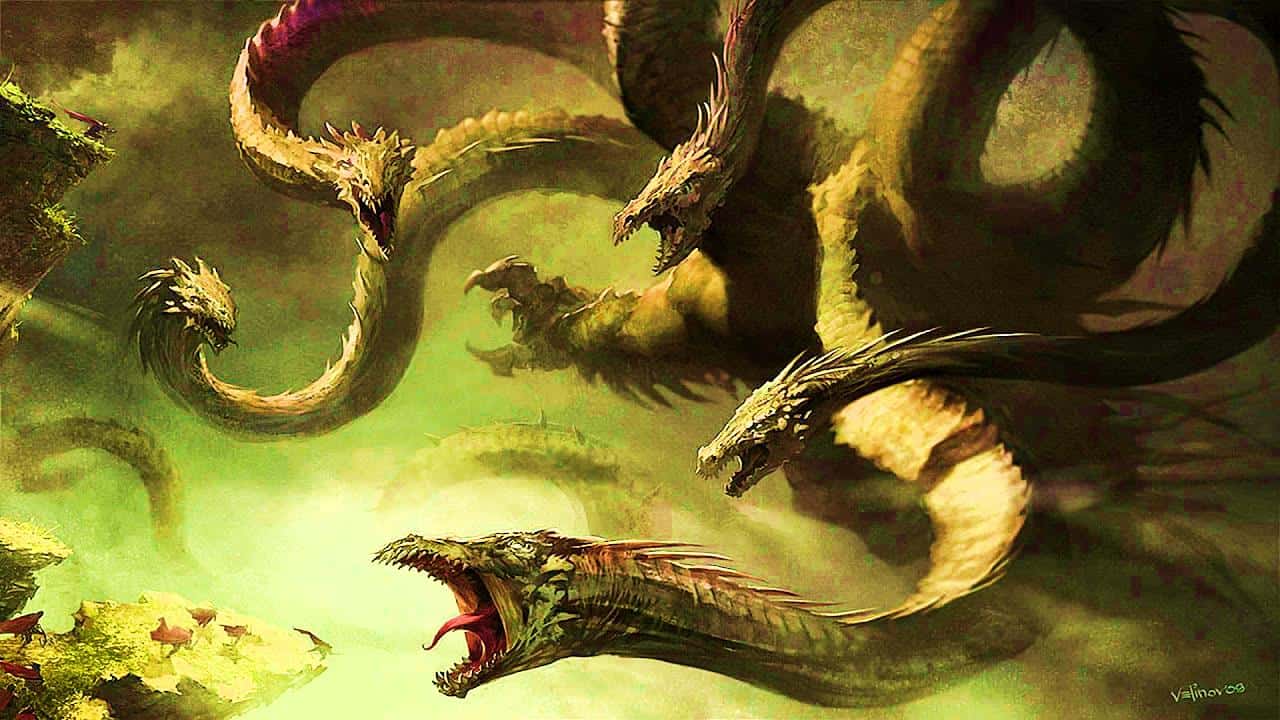
Synopsis:
Hydra, also called the Lernean Hydra, in Greek legend, the offspring of Typhon and Echidna (according to the early Greek poet Hesiod’s Theogony), a gigantic water-snake-like monster with nine heads (the number varies), one of which was immortal. The monster’s haunt was the marshes of Lerna, near Árgos, from which he periodically emerged to harry the people and livestock of Lerna. Anyone who attempted to behead the Hydra found that as soon as one head was cut off, two more heads would emerge from the fresh wound.
The destruction of the Lernean Hydra became one of the 12 Labours of Heracles. For that and other labours, Heracles enlisted the aid of his nephew Iolaus. As Heracles severed each mortal head, Iolaus was set to the task of cauterizing the fresh wounds so that no new heads would emerge. When only the immortal head remained, Heracles cut it off too and buried it under a heavy rock. Further, he dipped his arrows in the beast’s poisonous blood (or venom) to be able to inflict fatal wounds. According to Sophocles, that measure eventually caused his own accidental death at the hands of his wife, Deianeira.
The Lernaean Hydra, more often known simply as the Hydra, was a serpentine water monster in Greek and Roman mythology. Its lair was the lake of Lerna in the Argolid, which was also the site of the myth of the Danaids. Lerna was reputed to be an entrance to the Underworld and archaeology has established it as a sacred site older than Mycenaean Argos. In the canonical Hydra myth, the monster is killed by Heracles, more often known as Hercules, using sword and fire, as the second of his Twelve Labours.
According to Hesiod, the Hydra possessed many heads, the exact number of which varies according to the source. Later versions of the Hydra story add a regeneration feature to the monster: for every head chopped off, the Hydra would regrow a couple of heads.
The Hydra had poisonous breath and blood so virulent that even its scent was deadly.
Interpretation:
The hydra is a symbol of the striving to wish fulfilment, or greed.
Every time one head of the snake rolls of, another grows on.
35. Charybdis

Synopsis:
The sea monster Charybdis was believed to live under a small rock on one side of a narrow channel. Opposite her was Scylla, another sea-monster, that lived inside a much larger rock. The sides of the strait were within an arrow shot of each other, and sailors attempting to avoid one of them would come in reach of the other.
Interpretation:
The sea monsters symbolise the lower passions, which drag the soul, represented here by a ship and its crew, into a vortex and underwater.
The story tells a narrative of a psychological battle symbolised in a sailing ship in which the psychological complexes are represented as sea monsters.
36. Circe

Circe 1889, Wright Barker (British, 1863-1941)
Synopsis:
Circe the enchantress is described as living in a mansion that stands in the middle of a clearing in a dense wood. Around the house prowled strangely docile lions and wolves, the drugged victims of her magic; they were not dangerous, and fawned on all newcomers. Circe worked at a huge loom. She invited Odysseus’ crew to a feast of familiar food, a pottage of cheese and meal, sweetened with honey and laced with wine, but also laced with one of her magical potions, and drunk from an enchanted cup. Thus so she turned them all into swine with a wand after they gorged themselves on it. Only Eurylochus, suspecting treachery from the outset, escaped to warn Odysseus and the others who had stayed behind at the ships. Odysseus set out to rescue his men, but was intercepted by the messenger god, Hermes, who had been sent by Athena. Hermes told Odysseus to use the holy herb moly to protect himself from Circe’s potion.
Interpretation:
Circe symbolises the lower forces within a person. That she drugged her enemies and transforms humans into swine implies that hedonism degrades human functioning. Odysseus is protected by higher elements against this faith.
37. Nereid

Synopsis:
In Greek mythology, the Nereids are sea nymphs (female spirits of sea waters), the 50 daughters of Nereus and Doris, sisters to Nerites. They often accompany Poseidon, the god of the sea, and can be friendly and helpful to sailors.
This is related to a belief in the existence of a race, neither divine nor human, but very like to human beings, who existed on a “plane” different from that of humans, though occupying the same space.
They symbolized everything that is beautiful and kind about the sea. Their melodious voices sang as they danced around their father.
They are similar to the Ceffyl Dŵr, a water horse in Welsh folklore.
Nymph, in Greek mythology, any of a large class of inferior female divinities. The nymphs were usually associated with fertile, growing things, such as trees, or with water. They were not immortal but were extremely long-lived and were on the whole kindly disposed toward men. They were distinguished according to the sphere of nature with which they were connected. The Oceanids, for example, were sea nymphs; the Nereids inhabited both saltwater and freshwater; the Naiads presided over springs, rivers, and lakes. The Oreads (oros, “mountain”) were nymphs of mountains and grottoes; the Napaeae (nape, “dell”) and the Alseids (alsos, “grove”) were nymphs of glens and groves; the Dryads or Hamadryads presided over forests and trees.
Italy had native divinities of springs and streams and water goddesses (called Lymphae) with whom the Greek nymphs tended to become identified.
Interpretation:
The Nereids / sea nymphs are personifications of energies that are felt within nature mysticism.
38. Odyssey

19th-century-painting-Ivan-Konstantinovich-Aivazovsky- (29 July 1817 – 2 May 1900)
Introduction
The Odyssey is one of two major ancient Greek epic poems attributed to Homer. It is, in part, a sequel to the Iliad, the other work ascribed to Homer. The poem is fundamental to the modern Western canon, and is the second oldest extant work of Western literature, the Iliad being the oldest. It is believed to have been composed near the end of the 8th century BC, somewhere in Ionia, the Greek coastal region of Anatolia.
The poem mainly centers on the Greek hero Odysseus (known as Ulysses in Roman myths) and his journey home after the fall of Troy. It takes Odysseus ten years to reach Ithaca after the ten-year Trojan War. In his absence, it is assumed he has died, and his wife Penelope and son Telemachus must deal with a group of unruly suitors, the Mnesteres or Proci, who compete for Penelope’s hand in marriage.
Synopsis
The Odyssey begins ten years after the end of the ten-year Trojan War (that is the subject of the Iliad), and Odysseus has still not returned home from the war. Odysseus’ son Telemachus is about 20 years old and is sharing his absent father’s house on the island of Ithaca with his mother Penelope and a crowd of 108 boisterous young men, “the Suitors”, whose aim is to persuade Penelope to marry one of them, all the while enjoying the hospitality of Odysseus’ household and eating up his wealth.
Odysseus’ protectress, the goddess Athena, discusses his fate with Zeus, king of the gods, at a moment when Odysseus’ enemy, the god of the sea Poseidon, is absent from Mount Olympus. Then, disguised as a Taphian chieftain named Mentes, she visits Telemachus to urge him to search for news of his father. He offers her hospitality; they observe the Suitors dining rowdily while the bard Phemius performs a narrative poem for them. Penelope objects to Phemius’ theme, the “Return from Troy”, because it reminds her of her missing husband, but Telemachus rebuts her objections.
That night Athena, disguised as Telemachus, finds a ship and crew for the true Telemachus. The next morning, Telemachus calls an assembly of citizens of Ithaca to discuss what should be done with the suitors. Accompanied by Athena (now disguised as Mentor), he departs for the Greek mainland and the household of Nestor, most venerable of the Greek warriors at Troy, now at home in Pylos. From there, Telemachus rides overland, accompanied by Nestor’s son, Peisistratus, to Sparta, where he finds Menelaus and Helen who are now reconciled. He is told that they returned to Sparta after a long voyage by way of Egypt. There, on the island of Pharos, Menelaus encountered the old sea-god Proteus, who told him that Odysseus was a captive of the nymph Calypso. Incidentally, Telemachus learns the fate of Menelaus’ brother Agamemnon, king of Mycenae and leader of the Greeks at Troy: he was murdered on his return home by his wife Clytemnestra and her lover Aegisthus.
Escape to the Phaeacians
The second part tells the story of Odysseus. After having spent seven years in captivity on Calypso’s island, Ogygia, Calypso falls deeply in love with him but he has consistently spurned her advances. She is persuaded to release him by Odysseus’ great-grandfather, the messenger god Hermes, who has been sent by Zeus in response to Athena’s plea. Odysseus builds a raft and is given clothing, food and drink by Calypso. When Poseidon finds out that Odysseus has escaped, he wrecks the raft but, helped by a veil given by the sea nymph Ino, Odysseus swims ashore on Scherie, the island of the Phaeacians. Naked and exhausted, he hides in a pile of leaves and falls asleep. The next morning, awakened by the laughter of girls, he sees the young Nausicaa, who has gone to the seashore with her maids to wash clothes after Athena told her in a dream to do so. He appeals to her for help. She encourages him to seek the hospitality of her parents, Arete and Alcinous, or Alkinous. Odysseus is welcomed and is not at first asked for his name. He remains for several days, takes part in a pentathlon, and hears the blind singer Demodocus perform two narrative poems. The first is an otherwise obscure incident of the Trojan War, the “Quarrel of Odysseus and Achilles”; the second is the amusing tale of a love affair between two Olympian gods, Ares and Aphrodite. Finally, Odysseus asks Demodocus to return to the Trojan War theme and tell of the Trojan Horse, a stratagem in which Odysseus had played a leading role. Unable to hide his emotion as he relives this episode, Odysseus at last reveals his identity. He then begins to tell the story of his return from Troy.

Giovanni Domenico Tiepolo — The Procession of the Trojan Horse in Troy
Odysseus’ account of his adventures
After a piratical raid on Ismaros in the land of the Cicones, he and his twelve ships were driven off course by storms. They visited the lethargic Lotus-Eaters who gave two of his men their fruit which caused them to forget their homecoming, and then were captured by the Cyclops Polyphemus, escaping by blinding him with a wooden stake. While they were escaping, however, Odysseus foolishly told Polyphemus his identity, and Polyphemus told his father, Poseidon, that Odysseus had blinded him. Poseidon then curses Odysseus to wander the sea for ten years, during which he would lose all his crew and return home through the aid of others. After their escape, they stayed with Aeolus, the master of the winds and he gave Odysseus a leather bag containing all the winds, except the west wind, a gift that should have ensured a safe return home. However, the greedy sailors foolishly opened the bag while Odysseus slept, thinking it contained gold. All of the winds flew out and the resulting storm drove the ships back the way they had come, just as Ithaca came into sight.
After unsuccessfully pleading with Aeolus to help them again, they re-embarked and encountered the cannibalistic Laestrygonians. All of Odysseus’s ships except his own entered the harbor of the Laestrygonians’ Island and were immediately destroyed. He sailed on and visited the witch-goddess Circe. She turned half of his men into swine after feeding them cheese and wine. Hermes warned Odysseus about Circe and gave Odysseus a drug called moly which gave him resistance to Circe’s magic. Circe, surprised by Odysseus’ resistance, agreed to change his men back to their human form in exchange for Odysseus’ love. They remained with her on the island for one year, while they feasted and drank. Finally, guided by Circe’s instructions, Odysseus and his crew crossed the ocean and reached a harbor at the western edge of the world, where Odysseus sacrificed to the dead. He first encountered the spirit of crewmember Elpenor, who had gotten drunk and fallen from a roof to his death, which had gone unnoticed by others, before Odysseus and the rest of his crew had left Circe. Elpenor’s ghost told Odysseus to bury his body, which Odysseus promised to do. Odysseus then summoned the spirit of the old prophet Tiresias for advice on how to appease the gods upon his return home. Next Odysseus met the spirit of his own mother, who had died of grief during his long absence. From her, he got his first news of his own household, threatened by the greed of the Suitors. Finally, he met the spirits of famous men and women. Notably he encountered the spirit of Agamemnon, of whose murder he now learned, and Achilles, who told him about the woes of the land of the dead (for Odysseus’ encounter with the dead, see also Nekuia).
Returning to Circe’s island, they were advised by her on the remaining stages of the journey. They skirted the land of the Sirens, who sang an enchanting song that normally caused passing sailors to steer toward the rocks, only to hit them and sink. All of the sailors except for Odysseus, who was tied to the mast as he wanted to hear the song, had their ears plugged up with beeswax. They then passed between the six-headed monster Scylla and the whirlpool Charybdis,
Odysseus losing six men to Scylla, and landed on the island of Thrinacia. Zeus caused a storm which prevented them leaving. While Odysseus was away praying, his men ignored the warnings of Tiresias and Circe and hunted down the sacred cattle of the sun god Helios as their food had run short. The Sun God insisted that Zeus punish the men for this sacrilege. They suffered a shipwreck as they were driven towards Charybdis. All but Odysseus were drowned; he clung to a fig tree above Charybdis. Washed ashore on the island of Calypso, he was compelled to remain there as her lover until she was ordered by Zeus, via Hermes, to release Odysseus.
Return to Ithaca
Having listened with rapt attention to his story, the Phaeacians, who are skilled mariners, agree to help Odysseus get home. They deliver him at night, while he is fast asleep, to a hidden harbor on Ithaca. He finds his way to the hut of one of his own slaves, the swineherd Eumaeus. Athena disguises Odysseus as a wandering beggar so he can see how things stand in his household. After dinner, he tells the farm laborers a fictitious tale of himself: He was born in Crete, had led a party of Cretans to fight alongside other Greeks in the Trojan War, and had then spent seven years at the court of the king of Egypt; finally he had been shipwrecked in Thesprotia and crossed from there to Ithaca.
Meanwhile, Telemachus sails home from Sparta, evading an ambush set by the Suitors. He disembarks on the coast of Ithaca and makes for Eumaeus’s hut. Father and son meet; Odysseus identifies himself to Telemachus (but still not to Eumaeus), and they decide that the Suitors must be killed. Telemachus goes home first. Accompanied by Eumaeus, Odysseus returns to his own house, still pretending to be a beggar. He is ridiculed by the Suitors in his own home, especially by one extremely impertinent man named Antinous. Odysseus meets Penelope and tests her intentions by saying he once met Odysseus in Crete. Closely questioned, he adds that he had recently been in Thesprotia and had learned something there of Odysseus’s recent wanderings.
Odysseus’s identity is discovered by the housekeeper, Eurycleia, when she recognizes an old scar as she is washing his feet. Eurycleia tries to tell Penelope about the beggar’s true identity, but Athena makes sure that Penelope cannot hear her. Odysseus then swears Eurycleia to secrecy.
Slaying of the Suitors
The next day, at Athena’s prompting, Penelope maneuvers the Suitors into competing for her hand with an archery competition using Odysseus’ bow. The man who can string the bow and shoot it through a dozen axe heads would win. Odysseus takes part in the competition himself: he alone is strong enough to string the bow and shoot it through the dozen axe heads, making him the winner. He then turns his arrows on the Suitors and with the help of Athena, Telemachus, Eumaeus and Philoteus the cowherd, he kills all the Suitors. Odysseus and Telemachus hang twelve of their household maids, who had betrayed Penelope or had sex with the Suitors, or both; they mutilate and kill the goatherd Melanthius, who had mocked and abused Odysseus. Now at last, Odysseus identifies himself to Penelope. She is hesitant, but accepts him when he mentions that their bed was made from an olive tree still rooted to the ground. Many modern and ancient scholars take this to be the original ending of the Odyssey, and the rest to be an interpolation. (Wikipedia)
Interpretation:
The story of Odysseus and his journey home after the fall of Troy, symbolises the epic struggle of the soul to go back to its origin. The persons/ characters in the story are personifications of aspects within one person.

Penelope is the faithful wife of Odysseus, who keeps her suitors at bay in his long absence and is eventually reunited with him, symbolises higher aspect within the human psyche (the spirit, atman, the monade)
Telemachus’ name in Greek means “far from battle”, perhaps reflecting his absence from the Trojan War. Homer also calls Telemachus by the patronymic epithet “Odysseus’ son”. Possibly so named because his father Odysseus was a famously skilled archer. The archer refers to the ability to reach one’s goal.
Athena, is the symbol of wisdom, courage, and inspiration, that manifests itself during spiritual development.
Calypso‘s name is from kalyptō, meaning “to cover”, “to conceal”, “to hide”, or “to deceive”. According to Etymologicum Magnum her name means , i.e. “concealing the knowledge”, and stands for the lower mind that deceives itself. The island of Calypso symbolises the mind that is trapped by its limited functioning, which makes it impossible to “travel” further.
Hermes is a god of transitions and boundaries., and his main symbol is the herald’s staff, and stands for the ability for transformation to higher levels, the Greek kerykeion or Latin caduceus which consisted of two snakes wrapped around a winged staff refers to the kundalini.
A Cyclops in Greek mythology and later Roman mythology, was a member of a primordial race of giants, each with a single eye in the middle of his forehead. The name is widely thought to mean “round-eyed” or “circle-eyed”.
The Cyclops signifies the ego.
The island stands for the egocentric world that holds the soul imprisoned.
Odysseus spins a beam in Polyphemus’ eye, means the elimination of one’s egocentric view.
Odysseus is telling the Cyclops Polyphemus that his name is Οὖτις, “Nobody”, then escaping after blinding Polyphemus. When asked by other Cyclopes why he is screaming, Polyphemus replies that “Nobody” is hurting him, so the others assume that, “If alone as you are [Polyphemus] none uses violence on you, why, there is no avoiding the sickness sent by great Zeus; so you had better pray to your father, the lord Poseidon”.
By saying he is “Nobody”, Odysseus renounces his identification with the ego and he can escape from captivity.
Odysseus and his crew escape the cyclops, as painted by Arnold Böcklin in 1896
However: The most evident flaw that Odysseus sports is that of his arrogance and his pride, or hubris. As he sails away from the island of the Cyclopes, he shouts his name and boasts that nobody can defeat the “Great Odysseus”. The Cyclops then throws the top half of a mountain at him and prays to his father, Poseidon, saying that Odysseus has blinded him. This enrages Poseidon, causing the god to thwart Odysseus’ homecoming for a very long time. This means that the lower elements are still not eliminated.

Poseidon is one of the twelve Olympian deities of the pantheon in Greek mythology. His main domain is the ocean, and he is called the “God of the Sea”. Additionally, he is referred to as “Earth-Shaker” due to his role in causing earthquakes. Poseidon represents the forces of the unconscious.
Circe the enchantress is described as living in a mansion that stands in the middle of a clearing in a dense wood. Around the house prowled strangely docile lions and wolves, the drugged victims of her magic; they were not dangerous, and fawned on all newcomers. Circe worked at a huge loom. She invited Odysseus’ crew to a feast of familiar food, a pottage of cheese and meal, sweetened with honey and laced with wine, but also laced with one of her magical potions, and drunk from an enchanted cup. Thus so she turned them all into swine with a wand after they gorged themselves on it. Only Eurylochus, suspecting treachery from the outset, escaped to warn Odysseus and the others who had stayed behind at the ships. Odysseus set out to rescue his men, but was intercepted by the messenger god, Hermes, who had been sent by Athena. Hermes told Odysseus to use the holy herb moly to protect himself from Circe’s potion. Circe symbolises the lower forces within a person. That she drugged her enemies and transforms humans into swine implies that hedonism degrades human functioning.
Scylla was a monster with four eyes and six long necks equipped with grisly heads, each of which contained three rows of sharp teeth. Her body consisted of 12 tentacle-like legs and a cat’s tail, while four to six dog-heads ringed her waist. In this form, she attacked the ships of passing sailors, seizing one of the crew with each of her heads. Another symbol of the lower forces within a person.
The sea monster Charybdis was believed to live under a small rock on one side of a narrow channel. Opposite her was Scylla, another sea-monster, that lived inside a much larger rock. The sides of the strait were within an arrow shot of each other, and sailors attempting to avoid one of them would come in reach of the other. The sea monsters symbolises the lower emotions.

Ulysses and the Sirens Herbert James Draper (1863 – 1920)
In Greek mythology, the Sirens were dangerous yet beautiful creatures, portrayed as femme fatales who lured nearby sailors with their enchanting music and voices to shipwreck on the rocky coast of their island.The sirens symbolises the cravings, the desires that keeps one away from reaching ones (spiritual) destiny.
Antinous One of two prominent suitors vying for Penelope’s hand in marriage, the other being Antinous is presented as a violent, mean-spirited, and overly-confident character who willfully defiles Odysseus’ home while the hero is lost at sea. In an attempt to kill Telemachus, the son of Odysseus and Penelope, Antinous sends out a small band of suitors in the strait between Ithaca and rugged Same where there is a rocky isle called Asteris, to intercept the young prince on his journey back to Ithaca from the hall of Menelaus. The plan, however, fails, as Telemachus avoids the trap with help from the goddess Athena. Antinous is a prime example of disregard for the custom of xenia (guest-friend hospitality); rather than reciprocating food and drink with stories and respect, he and his fellow suitors simply devour Odysseus’ livestock. He also shows no respect for the lower-classed citizenry, as is exemplified when he assaults a beggar, who is actually Odysseus in disguise, with a chair, which even the other suitors disapprove of. Antinous is the first of the suitors to be killed. Drinking in the Great Hall, he is slain by an arrow to the throat shot by Odysseus.

Ulysses recognized by his nurse. Louis Jean-Francois Lagrenee. (1725- 1805)
Antinous represents the lower elements within the human psyche that threatens to eliminate the higher elements, here represented by Telemachus. Antinous represents the violent, mean-spirited elements in the human that defiles the human soul, and those elements must be eliminated.
They visited the lethargic Lotus-Eaters who gave two of his men their fruit which caused them to forget their homecoming. This means that, because of the lethargic state of mind, the soul forgets is true destiny.
After their escape, they stayed with Aeolus, the master of the winds and he gave Odysseus a leather bag containing all the winds, except the west wind, a gift that should have ensured a safe return home. However, the greedy sailors foolishly opened the bag while Odysseus slept, thinking it contained gold. All of the winds flew out and the resulting storm drove the ships back the way they had come, just as Ithaca came into sight. Meaning that when the higher element Odysseus is asleep the lower elements, greed take over and move the soul away from its destiny.
At Athena’s prompting, Penelope maneuvers the Suitors into competing for her hand with an archery competition using Odysseus’ bow. The man who can string the bow and shoot it through a dozen axe heads would win. Odysseus takes part in the competition himself: he alone is strong enough to string the bow and shoot it through the dozen axe heads, making him the winner. He then turns his arrows on the Suitors and with the help of Athena, Telemachus, Eumaeus and Philoteus the cowherd, he kills all the Suitors.

Bela Čikoš Sesija, (1864 – 1931) Odysseus kills the Suitors, 1898
That Odysseus alone is strong enough to string the bow, refers to the power to reach his goal and to eliminate the obstructions.
Show some love
"A philosophical treatise can be mostly written in object or process language,
but phenomenological descriptions must be by its very nature first person descriptions.
It is for this reason that self-observations, and personal experiences of the author are included."
Marinus Jan Marijs.